 After the Battle of the Isle of Wight on August 4th, both fleets continued eastward up the English Channel on a southwesterly wind. The following day found both fleets becalmed south of Beachy Head which signified the start of the Narrow Seas separating England from Continental Europe. During the delay, both sides took stock of the conditions of their ships and men and pondered their next moves.
Howard knighted several of his leading officers who had excelled in yesterday’s battle. Howard believed he had kept the Armada from anchoring beside the Isle of Wight. English ships to date had received no significant damage and had incurred very few casualties; however, they had failed to sink a Spanish ship or prevent the Armada’s overall advance.
Howard took some consolation that he had prevented the Armada from gaining a sheltering harbor, which was true as far as the Isle of Wight was concerned. The Spanish high admiral, the Duke of Medina Sidonia, had previously acceded to his captains demands to anchor at Spithead until they heard from the Duke of Parma. The plan was for Parma to embark his army in barges from Dunkirk and meet the Armada in the lower North Sea. The Armada would then escort Parma’s army to the mouth of the Thames.
Medina Sidonia received damage and casualty reports: all his ships were seaworthy (though several required repairs at sea). Casualties included 267 men killed in battle (and many more injured), plus 500 killed, injured, or captured during two non-combat mishaps. These figures were low given that there were almost 30,000 men in the fleet.
The Armada was critically short of cannonballs for its heavy naval guns. Medina Sidonia dispatched a swift ship to Dunkirk with messages asking Parma to put to sea and bring the Armada more powder and shot. Medina Sidonia warned his captains to stay in formation or face prosecution then he directed fleet-wide prayers and fasting. He knew his fleet would be vulnerable as it waited along Picardy’s open coastline so he was praying for God’s protection.
For his part, Howard was also short on ammunition and desired reinforcements before fighting the Armada again. He sent a ship to find Lord Henry Seymour who commanded 35 ships of the Channel Guard at the Downs Anchorage off Dover. He asked Seymour to meet him off the Picardy coast with extra ammunition so they could decisively confront the Armada and prevent the linkup with Parma.
In the afternoon of the following day, August 6th, the Armada dropped anchor off Wissant in Picardy (a few miles short of Calais). Dunkirk and Parma’s army were 37 miles up the coast. At the last minute, Medina Sidonia’s flagship suddenly anchored in hopes that the pursuing English fleet would overshoot and anchor downwind from the Armada. The Spanish ships were bunched up from the maneuver and Howard failed to fall for the ruse. His hundred-ship fleet anchored in formation 1-1/2 miles behind the Armada in an upwind position. Parma immediately sent dispatch ships to Dunkirk advising Parma of his arrival.
That evening Seymour arrived with reinforcements (including five major combatants) and anchored his column on the seaward side of Howard’s fleet. Howard now had 135 ships in five columns facing the Armada’s 120 ships. For the first time he outnumbered his foe, and he was growing confident enough to attack them again.
On the morning of August 7th, Medina Sidonia was visited by the French governor of nearby Calais who offered him advice but little else save for letting Calais merchants hawk produce to Armada ships at highly inflated prices. Because of neutrality he declined Medina Sidonia’s request to sell him cannon balls. He warned Medina Sidonia about the perils of the coast and departed. He had caught glimpses of the nearby English fleet and it unnerved him.
Later that morning, Medina Sidonia’s messengers returned from Dunkirk with disconcerting news – Parma’s forces were not prepared to embark and his little navy had few seaworthy ships. There was no way he could secure the shallows from the Dutch navy. Parma indicated he could not put to sea until the next spring tide which was thirteen days away. Parma also had no cannon balls of the requested caliber. The Spanish leadership was dumbfounded. The Armada was low on ammunition and anchored on an open coastline beside a huge enemy force that could resupply at will. Worse yet, the wind and tide were optimal for an English fireship attack against the crowded Armada ranks in the coming night.
Medina Sidonia’s fear of fireships was justified. During a morning council, Howard and his deputies had agreed to dispatch fireships into the Armada’s midst around midnight when the tide was right. Howard’s admirals agreed to attack tomorrow at first light and to fire into Spanish hulls from close range. They had learned from their previous mistakes in the English Channel. Eight ships of middling size were selected from the seaward (windward) columns. The ships were secretly prepared with combustibles and double-shotted cannons that would presumably cook off in the fire and create havoc among the anchored Spanish ships. A supply column arrived in the early evening and Howard’s ships frantically restocked their ammunition (a luxury not afforded to the Spanish).
Medina Sidonia appointed a daring young officer named Antonio Serrano to lead a force of small, nimble, ships to advance against the anticipated fireships and deflect them away from the Armada. Orders were disseminated throughout the fleet for ships to mark their mooring points with buoys and, if confronted by fire ships, to slip their moorings and move away in good order. They were to return to their original mooring points once the danger was past. The only hope the Armada had of achieving its mission was to remain anchored in place in tight defensive order until Parma was able to come out.
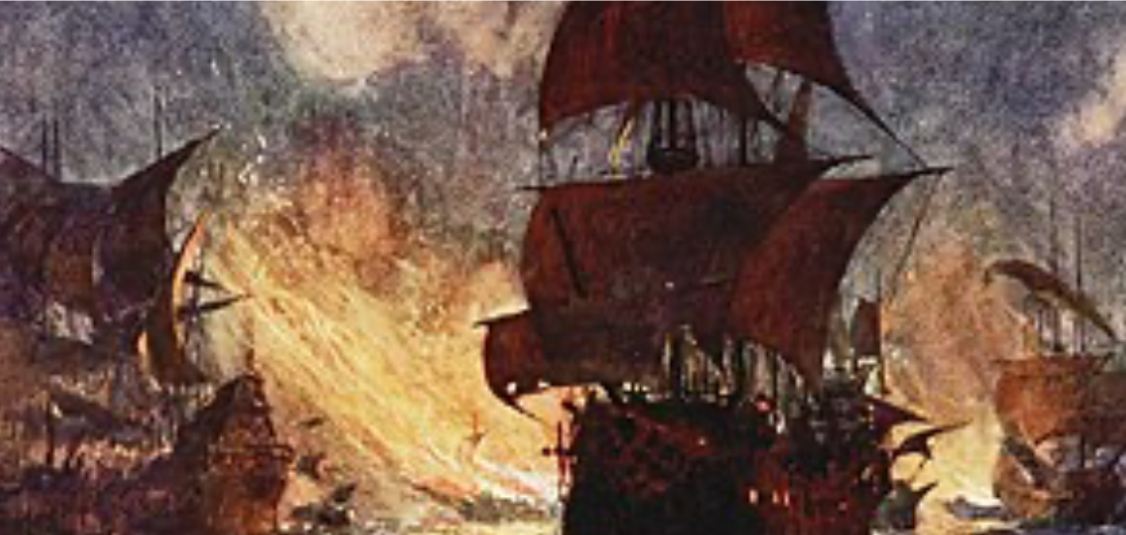
Just before midnight the English dispatched their eight fireships in a close formation of line abreast. The ships sailed rapidly downwind directly into the Spanish formation. The short distance involved gave the Spanish little time to react. English crews lit the combustibles, locked the sails and steering mechanisms into place, and evacuated to awaiting longboats. The unmanned fireships lit up the night in a Hellish inferno. Serrano advanced courageously forward and managed to deflect two fireships but the other six sailed straight into the Armada’s ranks.
As the flames surged up the fireships’ masts and sails, the cannons began cooking off. Erratic cannonballs were flung at high speeds in all directions. The nearest Spanish ship captains panicked. The plan for an orderly withdrawal quickly descended into a disorganized rout as every ship cut its anchor line and fled downwind up the coast. The English had finally broken the vaunted Spanish formation but the jury was out on whether they would successfully exploit the opportunity once daylight arrived. A climactic battle was destined to occur on the morrow that would decide the fate of Europe.
 Armada: The Invincible
Leave a comment