9 AUGUST 1588
After the squall in the late afternoon of August 8th separated the English and Spanish ships which had fought all day off Gravelines, both fleets set sail northeast along the Flemish coast. The Duke of Medina Sidonia knew the Armada was past the point where it could rendezvous with the Duke of Parma’s army at sea. The wind had veered to the northwest so the Armada was forced to continue up the coast with the English fleet trailing behind. The hazards of the Zeeland banks lay up ahead and the Armada was headed for disaster on their current heading. The English ships could more easily sail into the wind so they were further out to sea than the Armada and could block any Spanish attempt to gain deeper water.
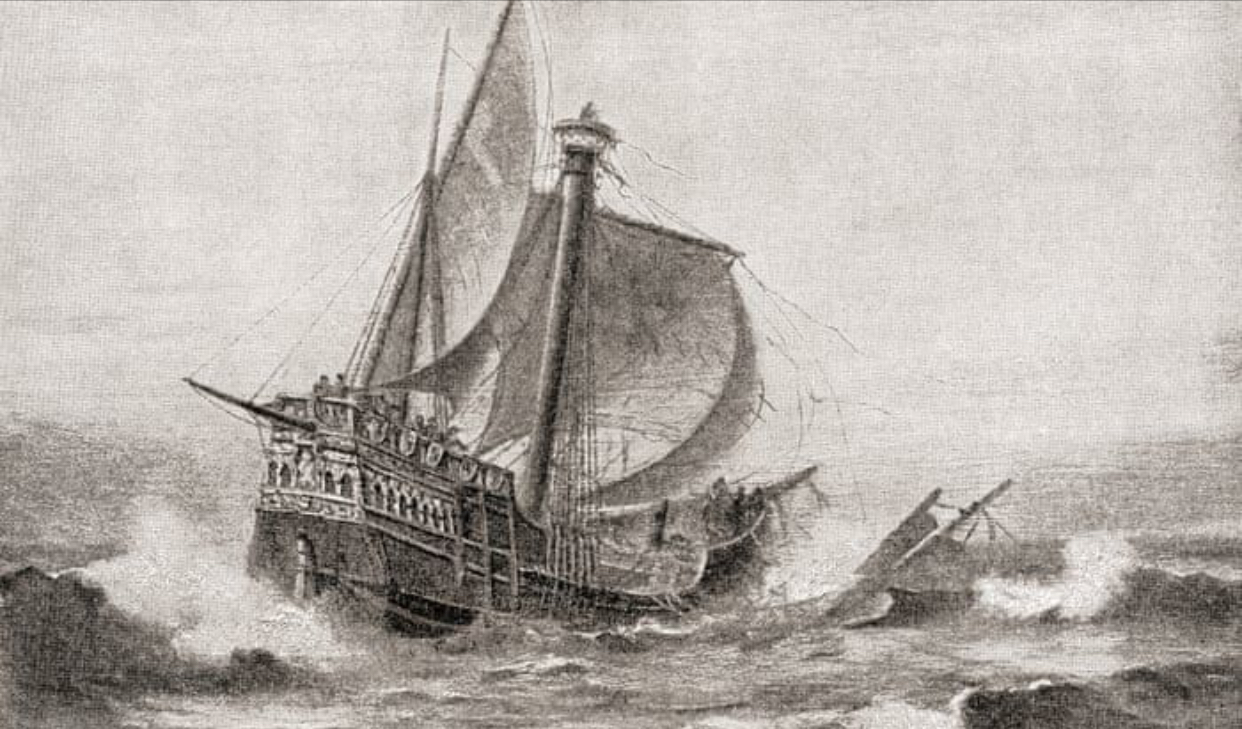
The English bombardment had severally damaged most of the Spanish ships, especially those which had opposed the joint assaults of Drake and Seymour. When the Armada reassembled after the storm, the Biscayan greatship Maria Juan foundered and sank, but fortunately most of her crew had been evacuated beforehand. During the night two large galleons from the Portuguese Squadron, San Felipe and San Mateo, were leaking so badly that their captains decided to drift landward and beach their ships on the Flemish sand banks so they could save their crews.
The following day a dozen Dutch shallow-draft warships led by Admiral Pieter Van der Does (accompanied by William Borlas, the English military governor of Flushing) captured both vessels on the sand flats. The crew of San Felipe gave up with out a fight (their officers having deserted them) but the crew of San Mateo offered a spirited resistance that killed many men on both sides. That evening the Dutch tossed the captured San Mateo crewmen over the side with their hands bound behind them and they were drowned. A storm in the night sank both ships off Flushing after they had been thoroughly ransacked. They had been holed by more than 300 cannon balls apiece during the fight off Gravelines so their hulls were too compromised to stay afloat any longer.
When dawn came on August 9th, Medina Sidonia’s flagship (San Martin) and five escorts were isolated from the rest of the Armada which lost its cohesion during the night. The main body of the fleet was a few miles downwind and Medina Sidonia’s small rearguard was facing the might of the English fleet alone. To the horror of Spanish observers, the Nuestro Senora de Begona went down with most of her crew while her captain was negotiating with Robert Crosse aboard his English galleon Hope regarding surrender terms. Afterward the English fleet charged toward the Spanish rearguard by column but each time the ships veered away without following a shot. It became clear the English were taunting their foes while conserving ammunition. Medina Sidonia found his ships drifting downwind toward the shoals in the face of the English provocations so he stopped trying to face down the English. He led his ships downwind toward the Spanish main body which had failed (or refused) to sail upwind to his aid.
During the next couple hours, the Armada was forced to skirt the coastal shallows as the English fleet sailed parallel to them further out to sea. As the water began changing colors the Spanish pilots knew they had come to the Zeeland sands. They nervously watched as the lead line casters counted less and less water under their ships’ keels. Prays were offered throughout the fleet for God’s intervention. The order went out for the Armada ships to drop anchors to slow their forward progress but the anchors merely dragged on loose sand. The end seemed near but suddenly the wind veered just enough to allow the Armada to tack seaward and avoid the disaster of running aground in rough seas. As Howard and his officers watched in chagrin, the Armada narrowly escaped yet again by the intervention of nature or God.
That evening both fleets reduced sails for the night as they slowly drifted toward the northern climes. Medina Sidonia held a council and after much debate he decided to head into the Norwegian Sea then westward to skirt the northern Scottish Isles. The pilots mapped a route designed to take them well past the west coast of Ireland before turning south toward Spain. Water and food rationing was implemented because they would barely have enough to last the 2,100-mile journey. The ‘Enterprise of England’ was over, but the Armada’s odyssey had just begun. It would be a grueling voyage home.
Meanwhile, Howard held a council and they decided to follow the Armada toward Scotland’s Firth of Forth, after which the fleet would return home because the threat of a Spanish landing in a British port would be gone. Howard and his admirals took stock of the situation: they were disappointed that the Armada had escaped intact but were grateful for their slight casualties and negligible shipboard damage. Drake summed up the campaign with optimistic words: “God hath given us so good a day in forcing the enemy so far to leeward as I hope to God the Prince of Parma and the Duke Medina Sidonia shall not shake hands this few days, and whenever they shall meet, I believe neither of them will greatly rejoice of this day’s service.”
 Armada: The Invincible
Leave a comment