19 August 1588
 After the pivotal Battle of Gravesend on August 8th (during which time the English Fleet brutalized the Armada with close-in cannon fire and drove it into the North Sea), Queen Elizabeth anxiously awaited news of the outcome. Lord Charles Howard had dispatched a messenger with an abbreviated account of the battle but the Queen lacked salient details and did not know whether the Armada would return. The Duke of Parma and his army of seventeen thousand professional soldiers at Dunkirk were waiting to embark on troop transports and make the short crossing to England on the impending spring tide. Since the English fleet was pursuing the Armada northward, Parma’s forces might make a surprise sortie and land around the mouth of the Thames in the coming days.
While Elizabeth waited at St. James’ Palace, she called a meeting of her Privy Councilors to discuss the military situation. To meet an expected invasion downriver, she had dispatched Robert Dudley, the Earl of Leicester, to command a militia army of approximately nine thousand men from Essex and Kent counties. Leicester was based at Tilbury near the mouth of the Thames where a black house and fort were being constructed to resist an attempt by Parma to move his forces upriver toward London. Meanwhile, London had mobilized ten thousand militiamen who were barricading every street opening and preparing to fight the Spanish block-by-block. Lord Hunsdon (Henry Carey, son of Elizabeth’s aunt, Mary Boleyn) was the 62-year-old Lord Chamberlain of the Queen’s Household. He had some previous military experience so he was selected to lead a reserve army near Westminster where the Queen would be kept in relative safety. Unfortunately, that army existed only on paper.
Elizabeth realized the realm was unprepared to meet Parma’s army on English soil but she was chafing at inactivity and desired to raise morale, so she readily took up a written offer from Leicester to review his troops at Tilbury.
On August 18th, Elizabeth took to her royal barge and led a military style procession of her household staff (and Privy Councilors) down the Thames. A couple hours later she emerged on deck wearing a military breastplate over her otherwise fashionable attire. When the procession pulled into a ferry dock on the north side of the Thames, she had a clear view of Leicester’s military preparations. A bridge of boats connecting West Tilbury to Gravesend was incomplete. An Italian engineer named Federigo Giambelli had recently constructed a boom across the eight-hundred-foot-wide river but it had broken in half at the first flood tide. The boom was made from anchor chains, ship masts and hemp cables that were secured to river barges in several sections. A two-story, D-shaped, brick blockhouse loomed over the shoreline on the Essex side. It contained twenty-three cannons that commanded the river. A brick-lined earthwork was under construction on the landward side to defend the blockhouse from an enemy incursion on that quarter.
Leicester brought the Queen through a gate in the rampart that enclosed a modest yard behind the blockhouse. Dozens of laborers had been working on the fortifications; they now stood with their hats in their hands as the Queen approached. Giambelli stood at their frontage; he was introduced to the Queen before Leicester brought her inside the blockhouse to inspect the cannons. Afterward they moved inland to inspect the nearby army encampment.
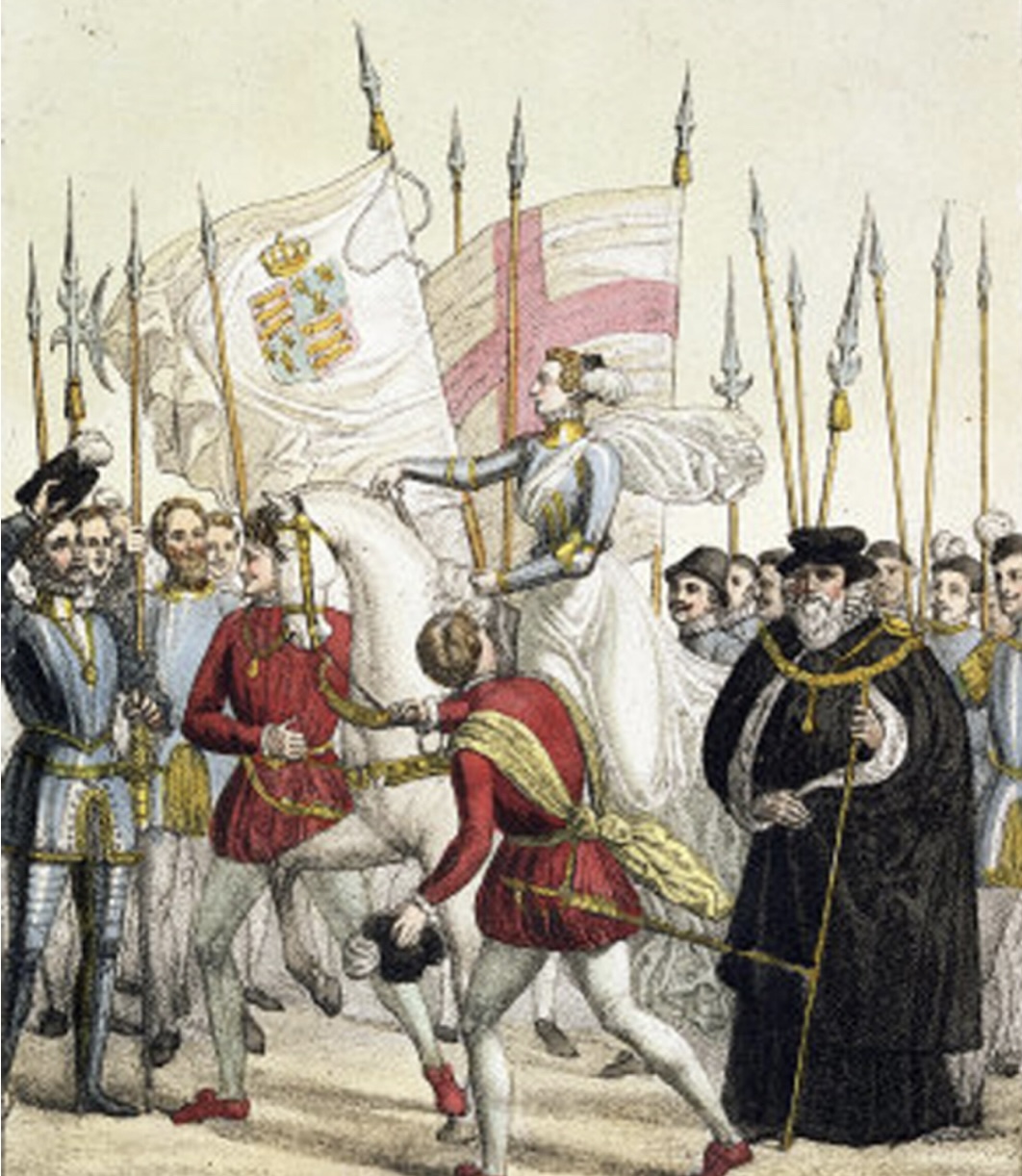
The yeomen of the guard and her gentlemen pensioners marched up a raised causeway that led inland over a marsh toward higher ground. They were followed by a dozen minstrels playing fifes and drums. The Queen was preceded by the Earl of Ormond who walked on foot carrying the ceremonial Sword of State, then two pages dressed in white velvet; one carrying the Queen’s silver casque on a white velvet cushion, and the other leading her horse by a rein. The Queen rode on a white gelding flanked on either side by two mounted men: the Master of the Horse (her cousin, the twenty-three-year-old Robert Devereaux, Earl of Essex); and Leicester, who rode with his head uncovered. Trailing her on foot was an armored soldier, Colonel Sir John Norris, who was Leicester’s military advisor and one of England’s few experienced army commanders. Leicester had arranged an honor guard along their route, so at thirty-four intervals within the space of a mile the Queen passed rows of pikemen who couched their eighteen-foot weapons as she passed.
The encampment was a close arrangement of tents surrounded by a wooden palisade and trench. Due to its newness, it was clean and orderly, and reminded Elizabeth of a country fair. It was situated on common strip fields outside the village center of West Tilbury and between the lofty tower of St. James’ Church and an old windmill. Her household guards arranged themselves in orderly rows outside the palisade, but Elizabeth and a few companions entered the camp through its main gate and slowly proceeded between every row of tents and through every corner of the encampment. Soldiers stood at attention and uttered ‘my Queen’ or ‘Gloriana’ as she passed. Many of them wept openly at the site of her. To some, she seemed like a manifestation of Diana or some other heroic biblical woman, while to others, she seemed like an avenging angel of the Lord. Despite her lack of bodyguards, she seemed untouchable, and no one held any thought of accosting her; rather, they looked upon her with quiet reverence until she passed, then they broke into cheers.
After completing a circuit of the camp, Elizabeth and her entourage followed a narrow lane northward for a few miles which took them over Mucking Heath to her lodging at ‘Cantis House (Saffron Gardens) that was owned by a local magistrate named Edward Rich. The house was near the village of Horndon-on-the-Hill. She was entertained there for the rest of the day.
The next day (August 19th), at mid-morning, Elizabeth arrived by procession to Leicester’s pavilion which was near the camp but further west along higher ground overlooking the blockhouse and the town of Gravesend across the river. Next to the pavilion were the richly adorned tents of Leicester’s staff officers beside a cleared area reserved for the military parade. Elizabeth again wore her ornamental armor, and she reclined atop the pavilion while the troops prepared for a parade.
The first man she saw was Lord Montagu riding at the head of his company of horse troopers with his son and grandson on either side of him. Gaudy plumes affixed to the troopers’ helmets bobbed as the horses cantered by. Ranks of pike-bearing militiamen followed and then a thousand musketeers on loan from London marched by, followed by more horse troopers and lastly Leicester arrayed in splendid armor atop his war horse.
After the parade, the Queen gave a rousing speech that included the following words: “Let tyrants fear. I have always so behaved myself that, under God, I have placed my chief strength and safeguard in the loyal hearts and good will of my subjects; and therefore I am come amongst you, as you see, at this time, not for my recreation and disport, but being resolved, in the midst and heat of the battle, to live and die amongst you all; to lay down for my God, and for my Kingdom, and my people, my honor and my blood, even in the dust.
“I know I have the body but of a weak and feeble woman, but I have the heart and stomach of a king, and of a king of England too, and think foul scorn that Parma or Spain, or any prince of Europe, should dare to invade the borders of my realm: to which rather than any dishonor shall grow by me, I myself will take up arms, I myself will be your general, judge, and rewarder of every one of your virtues in the field.” That evening, Elizabeth heard rumors that Parma was about to sally forth and she wanted to remain to personally contest his landing, but her ministers persuaded her instead to return to London and safety. Parma never came. Once he determined the Armada would not be returning, he decided to put his army into winter quarters inland. He would focus his attentions on subduing the breakaway Dutch provinces. The threat of invasion was past but Elizabeth’s martial legend had just begun.
 Armada: The Invincible
Leave a comment