Author blog
This is the Kevin J. Glynn author blog about the Spanish Armada of 1588. I have published a historical fiction novel about the epic voyage of the Armada and want to share what my research revealed.
29 July 1588
THE SPANISH ARMADA
reached the shores of England
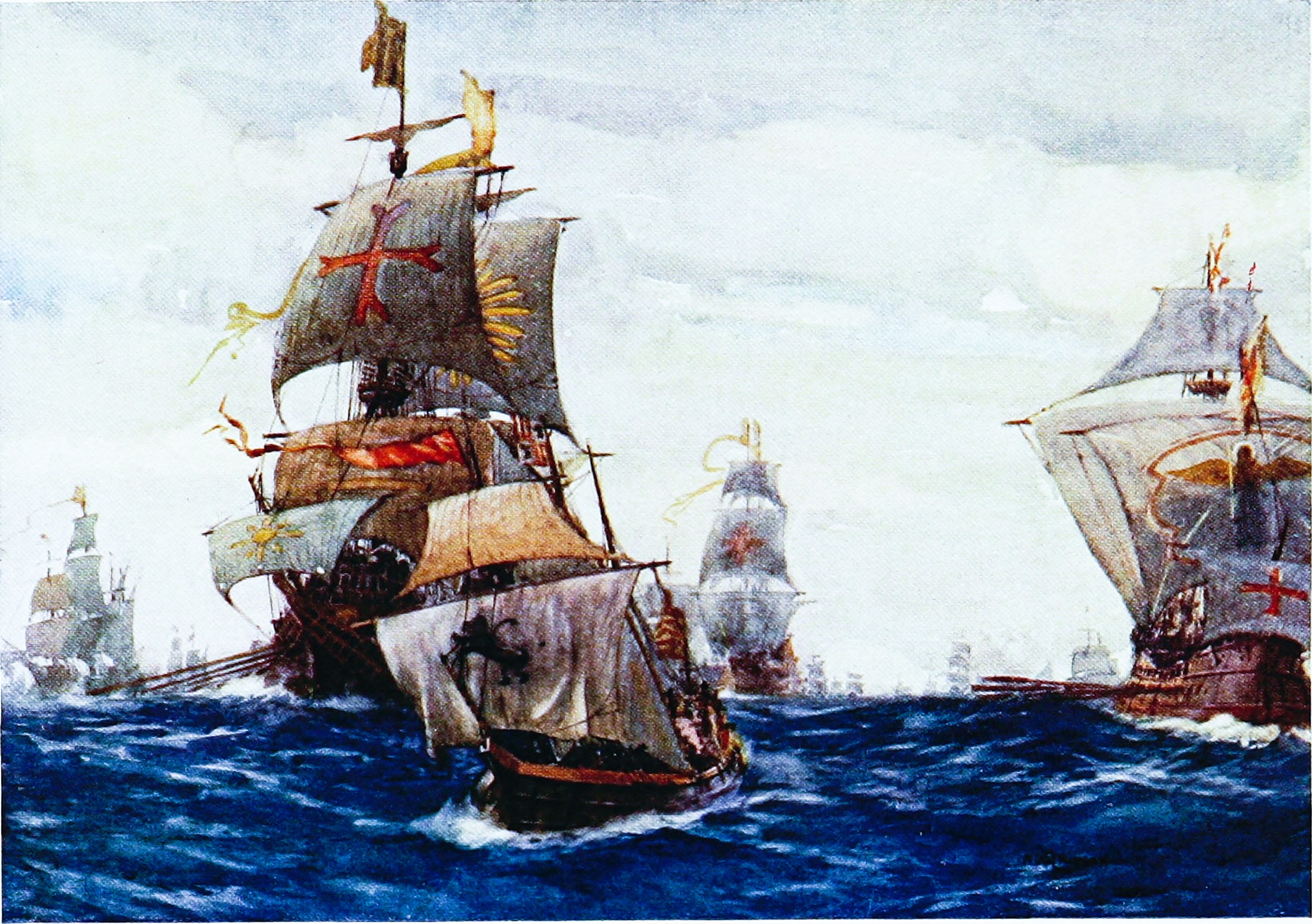
On this day in 1588, 123 ships of the Spanish Armada arrived off the Lizard Peninsula (the southernmost tip of Cornwall, England) after being partially scattered by a fierce storm off Brittany on 27 July. This vast war fleet, led by the Duke of Medina Sidonia, had left the port of Corunna in northwest Spain on 21-22 July. The Armada (which means ‘war fleet’ in Spanish) had been slowly gathering in Lisbon, Portugal ever since 1585 when King Philip II of Spain decided to build a fleet powerful enough to escort the Duke of Parma’s army in the Spanish Netherlands across the 25-mile-wide Dover Strait to invade England and depose Elizabeth I who was a nuisance to his reign.
After recovering from Sir Francis Drake’s 30-ship raid on Cadiz harbor in southern Spain (which destroyed 35 supply ships and thousands of tons of war materials meant for the Armada) Medina Sidonia had finally set sail with more than 130 ships from Lisbon on 30 May 1588. During the voyage north along the coastlines of Spain and Portugal, it was discovered that many barrels containing water and provisions were leaking badly due to the staves being made from green wood.
The Armada paused for four days off Cape Finisterre in northwest Spain (Galicia) while awaiting supply ships that never came, then Medina Sidonia decided to make for the nearby port of Corunna to resupply before crossing the dangerous Bay of Biscay toward England. The Armada pulled into Corunna on 19 June but almost half the fleet stayed at sea awaiting the daylight to pull into harbor due to safety reasons. In the early morning hours of 20 June, a gale swept in and scattered those ships across the Bay of Biscay. All but four (small) vessels returned but the Armada lingered in Corunna for another month while conducting repairs and being resupplied. Medina Sidonia finally set sail with 128 ships on 21-22 July.
The voyage north across the Bay of Biscay on a southerly wind (which unbeknownst to Medina Sidonia had blown a 90-ship English strike force back toward England) was initially uneventful. Unfortunately, the weather worsened off Brittany on 26-27 July and the Armada was driven westward by a powerful storm. Forty ships were separated from the main body. The four galleys of Lisbon (which were designed for placid Mediterranean waters) sought safety in French ports. The powerful flagship of the Biscayan Squadron never rejoined the fleet (the ship and crew eventually reached La Hogue, France where it remained. The rest of the Armada headed north toward a prearranged rendezvous point off the Scilly Islands (just offshore from the tip of Cornwall) – arriving on 28-29 July.
The 123-ship Armada consisted of 24 dedicated first-rate combatants (20 large galleons, four greatships and four galleasses) augmented by 40 auxiliary warships (converted large merchant ships stuffed with soldiers), plus 23 supply ships and 22 scouts. The Armada carried approximately 31,000 men (mariners, soldiers, rowers, and support personnel) and heavy siege guns meant for Parma’s army. The Armada also ferried 6,000 extra soldiers to augment Parma’s 17,000 effectives when or if Parma reached English shores.
During this time, the English had not been idle. On 2 June, England’s Lord High Admiral, Howard of Effingham, had arrived in Plymouth with 50 ships to augment Drakes 40 prepositioned ships. This 90-ship combined fleet consisted of 21 royal galleons and several powerful auxiliary warships supported by dozens of heavily armed auxiliary merchant ships and 23 supply ships (follow the link to see an Order of Battle for both fleets). This combined fleet carried almost 9,000 men and had far fewer shipboard soldiers than the Spanish; however, the English possessed a larger quantity of heavy long range naval guns.
After several weeks spent resupplying and gathering intelligence about the Armada, Howard exploited a brisk northerly wind and set sail from Plymouth on 17 July to strike the Armada in Corunna’s harbor. Unfortunately, the wind veered from the south when the English fleet was only half-way through the Bay of Biscay. Howard turned around and headed back to port without sighting the Armada which would soon advance on the same southerly wind. Howard returned to Plymouth on 22 July. Drake had the wherewithal to leave a string of scout ships across the mouth of the English Channel (between the French island of Ushant and the Scilly Islands) as a tripwire and Howard dispatched Drake’s deputy Thomas Fenner aboard the powerful royal galleon Nonpareil to search for the Armada off Brittany. The same storm that had scattered the Armada near Brittany drove Fenner westward and he never sighted the advancing Armada.
After its foray south, the English fleet had required several days to effect repairs, restock supplies, evacuate the infirmed men ashore, and take on new volunteers. The southerly wind favored the advancing Armada and threatened to confine the English ships to harbor or trap them against a lee shore. News reached Howard in the mid-afternoon of 29 July that the Armada was lying-to off the Scilly Islands some 90 sea miles away. Captain Thomas Fleming of the scout force brought word of his Armada sighting while Howard, Drake, and the other senior fleet officers were playing a game of lawn bowls on the grassy expanse of Plymouth Hoe. Upon hearing the news, Drake reportedly said: “We have time enough to finish the game and beat the Spaniards, too.”
After a war council, Howard took the advice of Drake and his other admirals (particularly John Hawkins, a local man who had led the eastern fleet in Chatham) to warp the fleet out of Plymouth Harbor once the tide started going out later that evening. Howard wanted to meet the Armada in the open waters of the English Channel and not get trapped in harbor or pinned against the shoreline by adverse winds. Around 10 pm, while the 123 ships of the Armada were hull-down off the Lizard Peninsula, the most powerful English warships (54 in all) commenced the laborious effort of putting to sea in the face of adverse winds. Howard famously uttered: “The southerly wind that brought us back from the coast of Spain brought them out. God blessed us with turning us back.” The stage was set for a long-awaited epic confrontation between two of the world’s most powerful fleets in the waters of the English Channel off Plymouth Sound.
My historical fiction novel “Armada: The Invincible” covers these dramatic events in a novelized format.
31 July 1588
EDDYSTONE ROCKS
First clash of titans
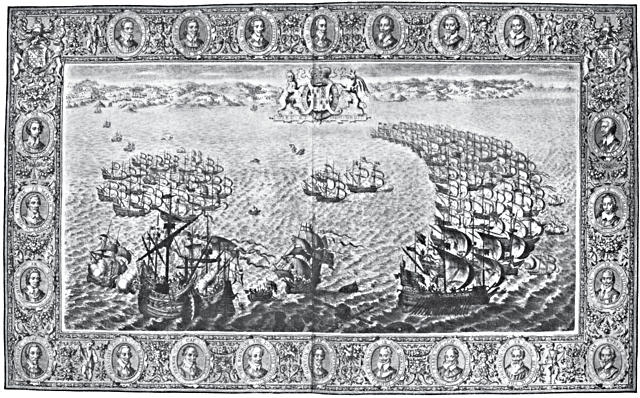
When dawn broke on 31 July 1588 off Plymouth harbor, an 11-ship column of English ships, led by Thomas Fenner (aboard the royal galleon Nonpareil) was tacking northwest toward the village of Looie (in Cornwall, England). The vanguard of the Armada – ten ships of the Levantine Squadron – were advancing in the opposite direction (east) toward the mouth of Plymouth Harbor. When Fenner reversed tack toward the enemy column, its admiral (Martin de Bertendona) and the de facto squadron leader (Don Alonso de Leyva) shifted their column into a line abreast formation to close on what they assumed was the vanguard of the English Combined Fleet. As Fenner’s column approached, the Levantine ships faced their broadsides toward the enemy and prepared for the opening salvo of the long-awaited contest.
After the Armada had reassembled off the Scilly Islands two days prior, the high admiral, the Duke of Medina Sidonia had advanced the fleet into the English Channel and paused off the Lizard Peninsula (the southernmost tip of Cornwall). After a war council in the morning of 30 July (during which time the Duke had refused to authorize an attack against Plymouth Harbor) the Armada slowly sailed on a following wind along the coastline of Cornwall and anchored for the night in St Austell Bay in line-ahead formation. Captured English fishermen had reported that a large English fleet led by the English High Admiral (Lord Charles Howard), had recently arrived at Plymouth to reinforce Sir Francis Drake’s western fleet. Medina Sidonia decided to drift laterally south southeastward during the darkness of the early morning of 31 July. Once dawn broke, he intended to advance the fleet in line ahead formation past the mouth of the English Channel. He did not plan to offer battle, but to form a defensive crescent if attacked and continue sailing up the English Channel to rendezvous with the Duke of Parma’s Army off Dunkirk in the Spanish Netherlands.
Meanwhile, Howard led 54 warships out of Plymouth harbor in the early morning of 30 July and anchored them nine miles into the English Channel behind a clump of shoals known as the Eddystone Rocks. One of his scouts had reported the presence of the Armada off the Scilly Islands the day before. Howard did not know the size of the Spanish Fleet but surmised it was comprised of more than fifty ships. In the late afternoon, during a break in the clouds, both fleets had sighted the distant mast tops of one another’s fleets. The wind had shifted out of the northwest, giving the Armada the advantage. Howard’s admirals (most likely Drake) proposed a flanking maneuver during the coming night so they could get in the Armada’s rear (upwind) and obtain a superior ‘weather gage’ position by dawn of the following day.
That afternoon, Thomas Fenner aboard Nonpareil arrived with the ships of the screening force. Drake sent him to Plymouth to conduct swift repairs to his ships and ordered him to lead the ten remaining heavy warships out of Plymouth at the first light of dawn, and then to advance west along the Cornish coastline to draw the Armada shoreward and away from Howard’s seaward flanking maneuver in the coming night.
At the first light of the following day (31 July) while Fenner was conducting an ineffective artillery duel with the Levantine ships, the main body of the English seaborne force had assembled in good order approximately seven sea miles west of the Eddystone Rocks. The Armada was strung out in a column seven miles long northeastward of the English fleet and closer to the shoreline. Fenner led his eleven ships southwest through a gap between the Levantine Squadron (the Armada vanguard) and the follow-on galleons of the Castilian Squadron. Once Fenner rejoined the English main body, Howard’s fleet was boosted up to 65 ships to oppose what the English now realized were 123 Spanish ships.
To the English amazement, the Armada then formed a huge defensive crescent shaped like a giant C almost seven miles wide, with the tips pointed backward toward the English fleet. The tips were occupied, respectively, by the Levantine Squadron (on the seaward side with de Leyva aboard his La Rata Encoronada at the position of honor) and the Biscayan Squadron with Vice Admiral Juan Martinez de Recalde (aboard the powerful galleon San Juan) on the landward side. Unbeknownst to the English at the time, Medina Sidonia (aboard San Martin) was assigned at the center of the Spanish ‘C’ behind the four galleasses of Naples in the customary Spanish position of honor.
Howard’s admirals advised him that it would be folly to attack the concavity of the crescent because the wings could close and trap them, so Howard decided to attack both wing tips simultaneously. Howard led a several-ship column aboard his flagship, Ark Royal, while Drake led a larger column of approximately ten ships against the seaward wingtip. Howard swung his ships across the seaward tip and exchanged fire with La Rata Encoronada and Admiral Bertendona’s carrack Regazona, but Howard’s ships fired from too far away to be effective. When the Levantine ships tried to force their way through his column, Howard withdrew the column upwind before most of his ships were even afforded the chance to fire their guns.
Meanwhile Drake (aboard his flagship Revenge) was focused on Recalde’s flagship San Juan which had inexplicitly fallen out of formation and was now landward and rearward from of Spanish fleet which was drifting slowly downwind. It is likely that Recalde wanted to induce a grappling melee with Drake’s advancing column. He may have anticipated drifting downwind and coming abreast of a halted Armada’s north-south access which would have allowed reinforcements to advance on a beam-reach tack against Drake. History does not record what Recalde intended, however. His isolated ship was savaged by Drake’s ships for over an hour from a range closer than Howard’s had been but still too far way to sink San Juan.
Drake withdrew upwind after his force had drifted into the lee of the Spanish main body. San Juan required towing to the safety of the supply ships. It took over two days of repairs at sea until San Juan was able to fight again. Fifteen of San Juan’s crew had been killed and perhaps 31 disabled during the fight with Drake’s column.
The English fleet reformed a few miles to the west of the Spanish crescent which had drifted well past the mouth of Plymouth Harbor by that time. The inconclusive battle had raged for five hours. Although he failed to disrupt the enemy formation, Howard figured he had prevented them from attacking Plymouth but he was intimidated by the size and strength of his enemy, which outnumbered him by almost two-to-one.
In the mid-afternoon, Medina Sidonia advanced the wingtip columns upwind against Howard in a futile attempt to force the English in a melee, then the Armada buttoned up its defensive crescent formation and turned downwind to resume its advance up Channel. That maneuver caused two ships of the Andalusian Squadron to collide. The huge armed carrack Nuestro Senora del Rosario lost her foremasts and drifted rearward out of the formation during the night. Medina Sidonia abandoned her even though she had a rear admiral and over 300 men left aboard her. An armed carrack of the Guipuzcoan squadron, San Salvador, blew up shortly afterward from a gunpowder mishap which killed over 100 men outright and burned as many more. The survivors were evacuated and the half-sunken hulk drifted rearward out of formation and was abandoned. The Armada advanced up Channel during the night with Howard’s ships trailing them from a comfortable distance.
Howard offered an assessment of the first day’s battle in a letter to Queen Elizabeth’s Principle Secretary, Sir Francis Walsingham, as follows: “We gave them fight from nine o’clock until one and made some of them to bear room to stop their leaks; not withstanding we durst not adventure to put in among them, their fleet being so strong.”
2 August 1588
PORTLAND BILL
Wind, Tide, and Gunpowder
After the inconclusive fight off the Eddystone Rocks on July 31st, Lord Charles Howard was intimidated by the Armada’s size and strength. He summoned his remaining ships from Plymouth, bringing his seaborne strength up to 90 vessels (but the reinforcements were mainly supply ships or smaller auxiliaries). Howard erroneously thought he had deterred the Armada’s high admiral (the Duke of Medina Sidonia) from seizing Plymouth Harbor. Howard decided to shadow the Armada and he sent letters to English port authorities asking for a host of small volunteer ships to resist a Spanish boat landing. He also requested that more ammunition be dispatched to his fleet and he was able to partially replenish his stock of cannon balls at sea (a luxury the Spanish did not have). Howard also decided to divide his major combatants into four columns that would stalk the Armada and look for opportunities to cut out individual ships. He would only attack en masse if the Armada seemed poised to seize an English port, otherwise he would wait until he joined the reinforced Channel Guard under Admiral Lord Henry Seymour off Dover. Only then would he fully engage the Armada in a decisive battle off the Picardy coast adjacent to the Duke of Parma’s embarkation port of Dunkirk.
For his part, Medina Sidonia was frustrated that his ships could not come to grips with the faster and more nimble English warships and he was frustrated over losing two major combatants and an admiral to the English due to mishaps (Sir Francis Drake and John Hawkins captured the abandoned ships, respectively). Medina Sidonia had his chance to kill or capture Howard on the morning of August 1st after Howard’s column blundered into the Armada’s formation in the dark. Howard discovered his error at daybreak. His flagship had been following Drake’s ship Revenge but Drake doused his stern lantern before sneaking out of formation to find the abandoned Nuestra Senora del Rosario (Drake received the surrender of the ship and sent her under escort into Tor Bay as a prize ship).
Medina Sidonia’s Admiral of the four galleasses of Naples (Hugo de Moncada) had asked permission to attack Howard’s column after it entered the Spanish ranks, but Medina Sidonia had thought Howard was engaged in a provocation and did not want to offer battle at that time. Howard was able to return to the English main body several miles to the rear.
Given that Admiral Recalde was seeing to repairs to his flagship San Juan after Drake’s brutal beatdown of July 31st, Medina Sidonia decided to organize the Armada into a small vanguard (led by himself) in the forward (downwind) side and a larger rearguard under Don Alonso Martinez de Leyva on the rear (upwind) side facing the English Fleet.
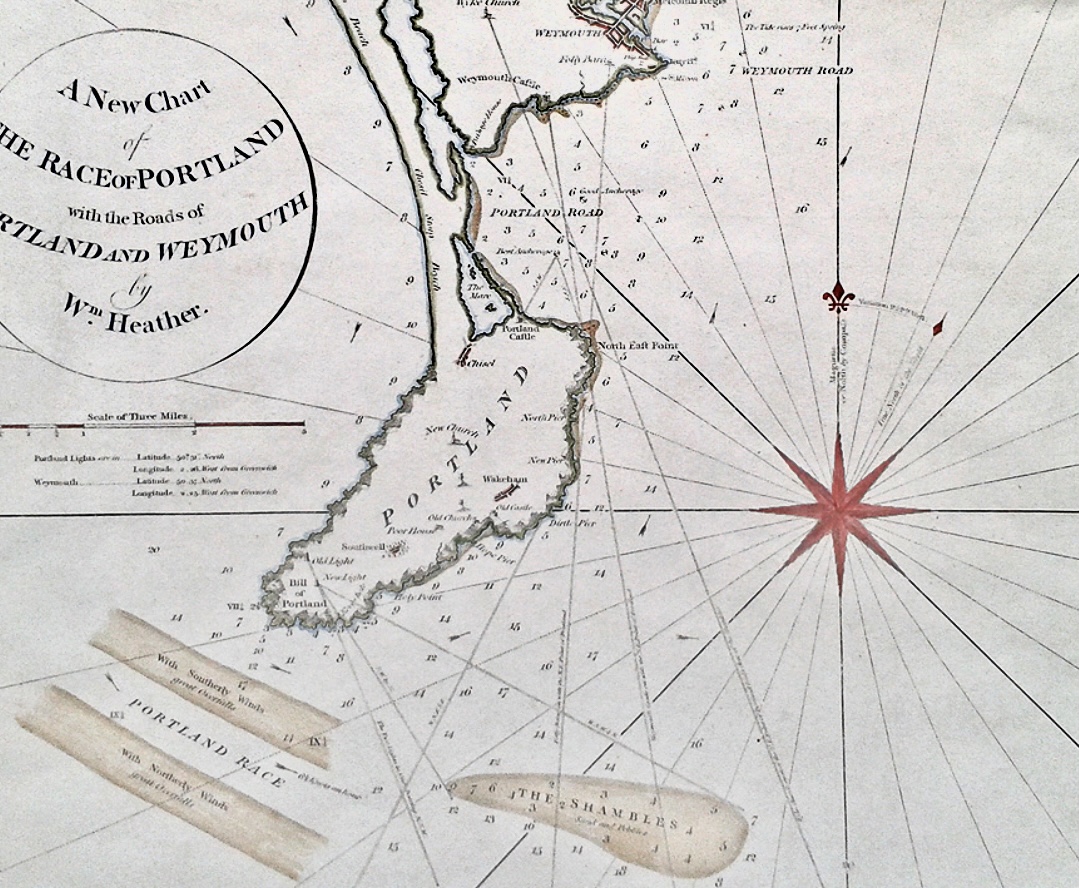
During the night both fleets were becalmed in Lyme Bay near Portland. Howard was worried that Medina Sidonia might try to seize the port of Weymouth and anchor in the sheltered waters of Portland Roads. The wind freshened out of the northeast around dawn on August 2nd, granting the Spanish the coveted weather gage (upwind position). Howard immediately sent his warships on a series of tacks to regain the wind from the landward side and block the Armada from entering Weymouth Bay. Medina Sidonia concurred with his advisors’ urgings and led his vanguard in a column formation toward the southern tip of Portland (the “Bill”) to cut off Howard.
Meanwhile, Leyva formed his 45-ship rearguard into a column and headed south in a long battle line to deny the English a seaward route to regain the wind. At the last minute, Howard ordered an early reverse tack and headed out to sea and away from Portland Bill and Medina Sidonia’s vanguard. He drew even with Leyva’s ships and engaged in a running sea battle for five hours while trying to regain the weather gage from that quarter. Leyva countered every flanking maneuver and attacked repeatedly downwind, but the nimble English galleons avoided every boarding attempt and fired prodigiously into the Spanish line. English gunners cycled their cannons almost three times faster than the Spanish, but they fired from too far away to cause serious damage. The Spanish ships kept up a steady barrage of light guns from their castles aimed at English rigging, sails, and aloft seamen. This caused the English ships to veer off before their maneuverability was degraded because they had few soldiers and needed the ability to sail to avoid Spanish efforts at clinching.
Around one o’clock the wind died down and both fleets on the seaward quarter lay becalmed several hundred yards away from each other. By this time Howard and Leyva’s forces had drifted westward across the outer reaches of Lyme Bay. Howard looked north and observed that Rear Admiral Martin Frobisher’s column of six ships (his giant greatship Triumph and five heavily armed London merchant auxiliaries) was isolated along the west side of Portland Bill behind a cordon maintained by Medina Sidonia’s vanguard.
When Howard had given the order in the morning for an abrupt tack out to sea, Frobisher had been unable or unwilling to comply because Triumph was less nimble than Howard’s ‘race-built’ galleons. Instead, he had taken his force into the lee of Portland Bill where he felt secure because of a tidal race that had formed between his force and the pursuing ships of the Spanish vanguard. Medina Sidonia assigned Moncada to lead his four galleasses (which could maneuver on both sails and oars) across the tidal race to attack Frobisher’s ships. Unfamiliar with the turbulent waters of the race, Moncada’s ships could not make headway. They were swept westward and out of range after exchanging ineffectual fire with Frobisher’s ships. Afterward, Medina Sidonia anchored his ships outside the race and awaited a slackening tide while the fighting raged out to sea between Howard and Leyva’s ships.
While Howard’s force lay becalmed, he was warned by his chief gunner that their ships were low on ammunition. The English had fired off more cannon balls in a single battle than any force in history up to that time, yet no serious damage had been sustained by either side. Howard began to realize that to be effective they would have to close within musket shot range of Spanish ships and aim for the hulls but that would subject his mariners to devasting anti-personnel counterfire. Howard digested this lesson but his captains were slow to implement tactical reforms.
In the mid-afternoon, the wind freshened from the south, granting Howard the weather gage over the northernmost Spanish forces. He decided to take his 20-ship column north to relieve Frobisher. When Medina Sidonia observed this, he abandoned the cordon of Frobisher, allowing him to escape, and tacked south with his 16 warships to meet Howard in deep water. Meanwhile, Recalde had finished repairs to his mighty San Juan. He unexpectantly tacked out of the midst of the Spanish supply ships and aimed at Howard’s flank as it passed into his lee. Seeing this, Drake broke away from Howard and led 12 ships to surround San Juan and pummel her from all sides. Howard continued forward against Medina Sidonia with his diminished column. To his amazement, 15 Spanish ships behind the Spanish flagship broke away and went to the aid of Recalde, leaving Medina Sidonia aboard his massive galleon San Martin facing Howard’s eight ships alone.
Howard’s column bombarded San Martin from medium range for over an hour, sending scores of cannon balls through her superstructure and decimating her rigging, before withdrawing in the face of Spanish reinforcements from Leyva’s rear guard. San Martin suffered modest casualties and sustained some serious leaks that needed patching, but she was still seaworthy. After repairs at sea, she would fight again in future battles (as would Recalde’s San Juan). Drake had abandoned his short but brutal assault against Recalde to join Howard in pummeling San Martin.
The battle off Portland Bill ended after Howard led all his warships safely upwind toward the end of the day (since they were almost out of ammunition) leaving the Armada free to reform its defensive crescent and continue sailing up the English Channel with the wind behind them. Howard’s four columns followed a few miles behind and looked for opportunities to pounce on stragglers. Howard wrongly thought his actions that day had prevented the Spaniards from trying to seizing the port of Weymouth, but he was disappointed at how little damage he had inflicted on the Spaniards despite what he called “a terrible value of great shot.”
4 August 1588
THE ISLE OF WIGHT
A port denied
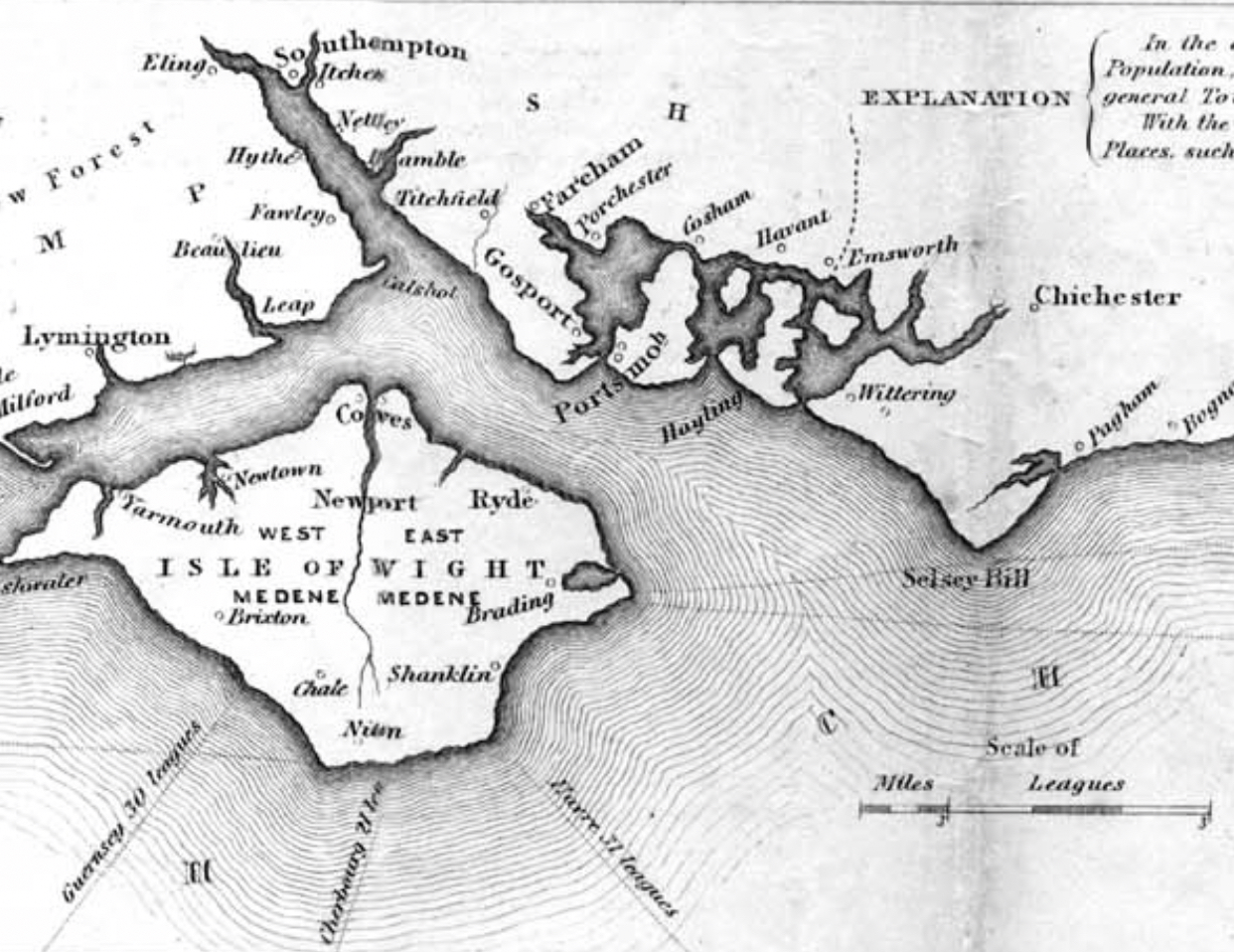
After the battle of Portland Bill on August 2nd, Lord Charles Howard led his 100-ship strong fleet in four columns behind the Spanish Armada which kept up its stately advance up the English Channel. At first light of the following day, August 3rd, Sir Francis Drake’s column came across the 650-ton flagship of the Armada’s Supply Squadron, Gran Grifon, which had fallen out of formation. Its captain, Juan Gomez de Medina, had not been vigilant during the night and he regretted it now. Drake immediately charged forward with his column and blasted Gran Grin from close range for over an hour. Most of the Spanish rearguard eventually tacked up wind to the rescue but after an inconclusive clash, Drake led his ships upwind without incurring significant casualties or shipboard damage. A galleass towed the stricken Gran Grin back into the Armada formation. Drake’s attack killed 60 Spaniards and injured scores more. It was a bloody harbinger of things to come.
Later that day, the wind died down and both fleets were becalmed for the remainder of the day and night. Dawn of August 4th found them several miles out to sea below Isle of Wight’s midpoint. Vice Admiral John Hawkins aboard Victory was delighted to see two straggling Spanish ships in front of his column. He ordered longboats to tow his column’s warships within cannon range of the stragglers and he engaged them in a stationary gunnery duel for a couple hours. The stragglers were the royal galleon Luis de Portugal and Santa Ana, an armed merchantman of the Andalusian Squadron. Three galleasses came to their rescue towing the huge armed carrack La Rata Encoronada (commanded by Alonso de Leyva). The galleasses harassed Hawkins’ ships and chased off his English longboats.
Howard (aboard Ark Royal) and his kinsman Lord Thomas Howard (aboard Golden Lion) were towed over to join the artillery duel. The galleasses eventually towed the stricken stragglers back into the fleet. The cobelligerents mutually disengaged from the fight once the wind came up.
While Hawkins and Howard were fighting the Spanish rearguard, Rear Admiral Martin Frobisher aboard the huge greatship Triumph was isolated from the main body of the English fleet. He was in command of the inland column which had drifted farther than anticipated eastward during the night. At dawn he found himself opposite the headland of Dunnose and was separated from his five London merchant escort ships by a few miles. Worse, the Spanish main body was interposed between him and the other English columns which were positioned southwestward and farther out to sea.
The Spanish High Admiral, the Duke of Medina Sidonia (assigned at the front of the vanguard) had ordered a galleass to tow his giant galleon San Martin up to Triumph and an artillery duel from medium range transpired for quite some time. The escorting galleass got behind Triumph and damaged her rudder head with a cannon ball. When the wind arose from the southwest, Medina Sidonia broke off from the fight and headed west with the galleass to order the ships at the landward tip of the Armada to move shoreward to cut off Frobisher’s escape route (the landward shoals would cut off his retreat from the opposite quarter).
Despite his peril, Frobisher could not sufficiently maneuver Triumph to catch the wind and he noticed many enemy ships approaching to grapple and board him. Fortunately, his distant escorts sent 11 longboats to him which towed Triumph westward and kept him out of reach of his pursuers. When the wind picked up more, he was able to hug the coastline and swiftly escape his trap under full sails before the Armada’s landward wing could close the gap and trap him.
Howard had noticed Frobisher’s predicament from afar and afterward tried to barge his way through the Spanish rearguard to come to his rescue. Ark Royal was almost grappled by Admiral Recalde’s San Juan and several other Spanish galleons but Howard staved them off with the help of two enormous English galleons, White Bear and Elizabeth Jonas. Together the English relief force fired prodigiously into the Spanish ranks and drove them back. Seeing Triumph‘s escape, Howard disengaged from the fight and led his column up wind to conduct minor repairs and ammunition replenishment from supply ships.
After this fight, Medina Sidonia tried to reform the Armada’s ranks. He took counsel from his advisors who wanted to anchor the Armada in the secure Spithead Anchorage inside the nearby eastern mouth of the Solent (behind the Isle of Wight). Medina Sidonia had previously agreed to pause at Spithead and await communications with the Duke of Parma before advancing further. He had dispatched swift vessels ahead to advise Parma of the Armada’s approach so Parma could be ready to embark his army in barges from Dunkirk as soon as the Armada arrived. Medina Sidonia did not want to linger in the open shoreline along Picardy, France while awaiting Parma’s embarkation. There was yet no word Parma but the winds and tides were perfect for entering the Solent where the Spanish might secure fresh water and extort or steal more ammunition while waiting. Unfortunately for the Spanish, Drake had something else in mind.
During the fighting on the landward side of the Armada formation, Drake had declined to offer battle from the seaward side. Instead, he had merely demonstrated to keep the adjacent Spanish ships from joining the fight with Hawkins, Howard and Frobisher. After the fighting stopped, Drake held a quick war council with his friend John Hawkins whose column was immediately adjacent to Drake’s and further landward. They were both worried that Medina Sidonia might make a go for Spithead, so Drake and Hawkins decided to attack the seaward Spanish rearguard and herd them toward the perils of a line of shoals known as the Owers that ran southeast from Selsey Point (on the far side of the Solent’s mouth). The Owers were not readily visible from the surface except for discoloration in the water and they hoped the Spanish would not notice their peril until it was too late.
Drake advanced his column against the seaward wingtip of the Armada and drove back the mighty San Mateo, then the giant Florencia, while Hawkins attacked from his adjacent sector. The English ships drew close and fired broadsides at enemy rigging to degrade their foes’ mobility and to drive them northeastward toward the shoals. The proverbial good order of the Spanish formations was impaired and the rearguard decoupled from the vanguard which remained fixed on the spent columns of Howard and Frobisher further inland.
At the last minute, Medina Sidonia was apprised of the peril of the shoals and he abandoned the notion of entering the Solent. Instead, he turned his vanguard ships 90 degrees southeastward and skirted the Owers out to sea. The rear guard formed up and followed and by mid-afternoon the Armada had resumed its formidable crescent formation and continued up the English Channel. Howard’s four columns followed them as before. There was no suitable English port remaining for the Spanish to take shelter in. Both sides knew that a climactic battle would have to be fought off the open coastline of France near Calais.
7 August 1588
ENGLISH FIRESHIPS ATTACK
Along the Picardy Coast
 After the Battle of the Isle of Wight on August 4th, both fleets continued eastward up the English Channel on a southwesterly wind. The following day found both fleets becalmed south of Beachy Head which signified the start of the Narrow Seas separating England from Continental Europe. During the delay, both sides took stock of the conditions of their ships and men and pondered their next moves.
Howard knighted several of his leading officers who had excelled in yesterday’s battle. Howard believed he had kept the Armada from anchoring beside the Isle of Wight. English ships to date had received no significant damage and had incurred very few casualties; however, they had failed to sink a Spanish ship or prevent the Armada’s overall advance.
Howard took some consolation that he had prevented the Armada from gaining a sheltering harbor, which was true as far as the Isle of Wight was concerned. The Spanish high admiral, the Duke of Medina Sidonia, had previously acceded to his captains demands to anchor at Spithead until they heard from the Duke of Parma. The plan was for Parma to embark his army in barges from Dunkirk and meet the Armada in the lower North Sea. The Armada would then escort Parma’s army to the mouth of the Thames.
Medina Sidonia received damage and casualty reports: all his ships were seaworthy (though several required repairs at sea). Casualties included 267 men killed in battle (and many more injured), plus 500 killed, injured, or captured during two non-combat mishaps. These figures were low given that there were almost 30,000 men in the fleet.
The Armada was critically short of cannonballs for its heavy naval guns. Medina Sidonia dispatched a swift ship to Dunkirk with messages asking Parma to put to sea and bring the Armada more powder and shot. Medina Sidonia warned his captains to stay in formation or face prosecution then he directed fleet-wide prayers and fasting. He knew his fleet would be vulnerable as it waited along Picardy’s open coastline so he was praying for God’s protection.
For his part, Howard was also short on ammunition and desired reinforcements before fighting the Armada again. He sent a ship to find Lord Henry Seymour who commanded 35 ships of the Channel Guard at the Downs Anchorage off Dover. He asked Seymour to meet him off the Picardy coast with extra ammunition so they could decisively confront the Armada and prevent the linkup with Parma.
In the afternoon of the following day, August 6th, the Armada dropped anchor off Wissant in Picardy (a few miles short of Calais). Dunkirk and Parma’s army were 37 miles up the coast. At the last minute, Medina Sidonia’s flagship suddenly anchored in hopes that the pursuing English fleet would overshoot and anchor downwind from the Armada. The Spanish ships were bunched up from the maneuver and Howard failed to fall for the ruse. His hundred-ship fleet anchored in formation 1-1/2 miles behind the Armada in an upwind position. Parma immediately sent dispatch ships to Dunkirk advising Parma of his arrival.
That evening Seymour arrived with reinforcements (including five major combatants) and anchored his column on the seaward side of Howard’s fleet. Howard now had 135 ships in five columns facing the Armada’s 120 ships. For the first time he outnumbered his foe, and he was growing confident enough to attack them again.
On the morning of August 7th, Medina Sidonia was visited by the French governor of nearby Calais who offered him advice but little else save for letting Calais merchants hawk produce to Armada ships at highly inflated prices. Because of neutrality he declined Medina Sidonia’s request to sell him cannon balls. He warned Medina Sidonia about the perils of the coast and departed. He had caught glimpses of the nearby English fleet and it unnerved him.
Later that morning, Medina Sidonia’s messengers returned from Dunkirk with disconcerting news – Parma’s forces were not prepared to embark and his little navy had few seaworthy ships. There was no way he could secure the shallows from the Dutch navy. Parma indicated he could not put to sea until the next spring tide which was thirteen days away. Parma also had no cannon balls of the requested caliber. The Spanish leadership was dumbfounded. The Armada was low on ammunition and anchored on an open coastline beside a huge enemy force that could resupply at will. Worse yet, the wind and tide were optimal for an English fireship attack against the crowded Armada ranks in the coming night.
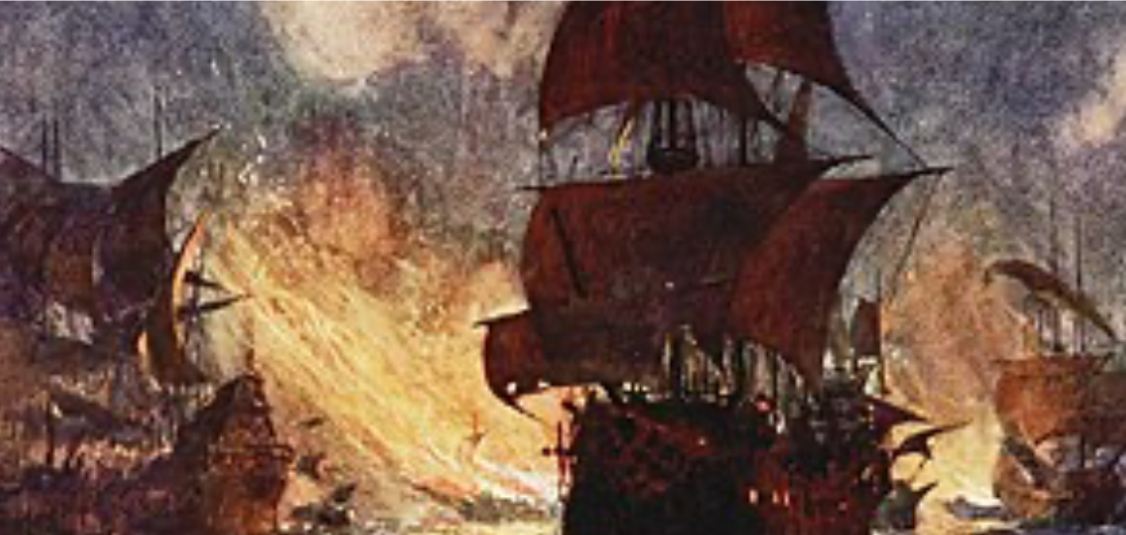
Medina Sidonia’s fear of fireships was justified. During a morning council, Howard and his deputies had agreed to dispatch fireships into the Armada’s midst around midnight when the tide was right. Howard’s admirals agreed to attack tomorrow at first light and to fire into Spanish hulls from close range. They had learned from their previous mistakes in the English Channel. Eight ships of middling size were selected from the seaward (windward) columns. The ships were secretly prepared with combustibles and double-shotted cannons that would presumably cook off in the fire and create havoc among the anchored Spanish ships. A supply column arrived in the early evening and Howard’s ships frantically restocked their ammunition (a luxury not afforded to the Spanish).
Medina Sidonia appointed a daring young officer named Antonio Serrano to lead a force of small, nimble, ships to advance against the anticipated fireships and deflect them away from the Armada. Orders were disseminated throughout the fleet for ships to mark their mooring points with buoys and, if confronted by fire ships, to slip their moorings and move away in good order. They were to return to their original mooring points once the danger was past. The only hope the Armada had of achieving its mission was to remain anchored in place in tight defensive order until Parma was able to come out.
Just before midnight the English dispatched their eight fireships in a close formation of line abreast. The ships sailed rapidly downwind directly into the Spanish formation. The short distance involved gave the Spanish little time to react. English crews lit the combustibles, locked the sails and steering mechanisms into place, and evacuated to awaiting longboats. The unmanned fireships lit up the night in a Hellish inferno. Serrano advanced courageously forward and managed to deflect two fireships but the other six sailed straight into the Armada’s ranks.
As the flames surged up the fireships’ masts and sails, the cannons began cooking off. Erratic cannonballs were flung at high speeds in all directions. The nearest Spanish ship captains panicked. The plan for an orderly withdrawal quickly descended into a disorganized rout as every ship cut its anchor line and fled downwind up the coast. The English had finally broken the vaunted Spanish formation but the jury was out on whether they would successfully exploit the opportunity once daylight arrived. A climactic battle was destined to occur on the morrow that would decide the fate of Europe.
8 August 1588
THE BATTLE OF GRAVELINES
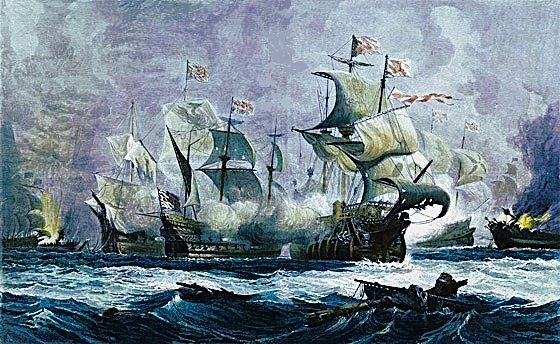
Just before midnight on 7 August 1588, the English high admiral, Lord Charles Howard, had sent six fireships into the midst of the Spanish Armada that was anchored in dense ranks off Wissant, France. The vast flames of burning masts and rigging and the blasts of ruptured double-loaded cannons had panicked the Spanish ship captains. Despite instructions to orderly evade any fireships and return to their original moorings, the Armada’s captains had fled downwind up the coast in a disordered route.
When dawn broke on August 8th, Howard nervously peered northward expecting to be disappointed. Too often had he seen the Armada reforming its vaunted defensive crescent after every battle. To his delight, he saw that the Armada ships were scattered to the horizon. The fireship attack had been successful. Only a single cluster of five warships had staked ground seven miles up the coast. The Spanish high admiral, the Duke of Medina Sidonia (aboard his flagship San Martin with four faithful escorts) would bear the brunt of the initial English assault.
During yesterday’s war council, it was agreed that Howard would lead the first column against the enemy, followed by the other four columns. When dawn revealed an isolated Spanish warship limping along the adjacent shoreline, Howard altered the plan. The galleass San Lorenzo, carrying Admiral Hugo de Moncada, had collided with a neighboring ship during the fireship attack. She had lost her mainmast and rudder and listed heavily to one side. Once Moncada realized his ship was isolated and likely to sink, he made for the safety of neutral Calais. Unfortunately, San Lorenzo ran aground just short of her destination and toppled over. She was soon stranded on the flats as the tide receded while Howard and Seymour’s columns bore down on her position. Howard wanted to seize a prize ship in pursuit of his own glory. He figured he would have plenty of time to reinforce Drake once the battle blossomed up north.
Howard sent several small vessels toward the stranded galleass. The assault force was directed by Captain John Fisher aboard the London merchant ship Margaret and John, which promptly ran aground near its target. Nevertheless, Fisher partnered with Howard’s nominated land captain, Amyas Preston, and a plan was hatched to deposit a hundred English soldiers onto the sand flats while a dozen small ships provided fire support. After a short but sharp engagement, most of San Lorenzo’s crewmen fled on foot toward shore but dozens of defenders were killed or captured. Admiral Moncada was fatally shot while leading a counter assault on foot, while Preston was shot through the hip (he later recovered). Three hundred convict oarsmen were liberated and a treasure coffer containing 21,000 gold escudos (the equivalent of 1.8 million pounds sterling in modern currency) was captured.
While the Englishmen were ransacking San Lorenzo, curious townsfolk wandered over the sand flats from Calais. A scuffle ensued and some townsfolks were robbed of their clothes and possessions. The enraged Calais governor ordered his fortress to open fire on the Englishmen who soon returned to their ships. Margaret and John was hit by cannon balls but later refloated and rejoined the fleet. Howard did not want to start a war with France, so he led his ships up the coast toward Gravelines where a giant sea battle was taking shape.
In Howard’s absence, Sir Francis Drake (his vice admiral) led his column against San Martin and sailed close enough to hole her many times with his heavy ordnance. Several other galleons in his column followed suit and soon San Martin was leaking badly. Drake then noticed Admiral Recalde’s giant flagship San Juan rallying a dozen warships a few miles up the coast. Recalde was trying to reform a wing, while reinforcements coming to San Martin’s aid would probably try to form another wing. Drake led his column downwind to disrupt Recalde’s efforts, leaving San Martin and her rescuers in the care of four English columns (Howard’s column would join the fighting on that quarter).
Rear Admiral Martin Frobisher’s column was the next to savage San Martin. Frobisher’s greatship Triumph was similarly sized as his opponent and he sailed close enough to make his shots count. Other English ships tangled with the relieving ships and a major battle broke out in that quarter. Edward Fenton, aboard Mary Rose, fought the huge galleon San Marcos for over an hour, pounding her superstructure into ruins and weakening her hull to the extent that she would need three cables running beneath her keel to stay intact. Every time the Spanish tried to grapple and board, English ships would veer away then return from another wind angle to fire more volleys. Eventually the Spanish ships started running out of ammunition allowing the English to come close and fire effectively into enemy hulls. English fire killed most of the opposing soldiers, lessening the threat of Spanish anti-personnel fire.
Meanwhile, Drake’s attack against a dozen Spanish combatants further north was running out of steam but he was reinforced by Lord Henry Seymour (aboard the powerful galleon Rainbow) who led several warships to that sector. Seymour’s fresh ships were fully stocked with ammunition which he fired from close quarters against several Spanish galleons in Recalde’s burgeoning wing. Seymour and Drake managed to cut off the Portuguese galleons San Felipe and San Mateo and battered them with cannonballs. Both ships lost much of their men and were so badly damaged that they would run aground to avoid sinking during the coming night. Four Spanish warships tried to rescue their colleagues but they had no ammunition left. They received a brutal beatdown by Seymour and Drake’s ships. Trinidad Valencia fled back to the relative safety of Recalde’s nascent wing but the other three collided and became entangled. San Juan de Sicilia, Maria Juan, and Nuestro Senora de Begona drifted helplessly as more than a dozen English ships fired volley after volley into them from close range (all three ships would sink from damage after the battle ended).
Drake and Seymour were later joined by Howard and the rest of the English fleet which had sailed downwind to join in the slaughter. Medina Sidonia and his relief ships used the respite to patch their most serious leaks and replace damaged rigging and sails. By the early afternoon they joined the melee up north. Howard temporarily withdrew upwind so his ships could make minor repairs.
Seeing that the Armada was using the respite to reorganize its ranks, Howard led his columns forward again and ranged freely among the enemy ships which had no ammunition left to resist. Auxiliary ships and supply ships were bombarded from close range and the Armada was nearing destruction but nature chose to intervene. A violent storm blew up from the south and separated the belligerents. Howard’s ships withdrew upwind, anchored in place, and rode out the storm. An hour later (around five o’clock), Howard was amazed to see that the Armada had retired downwind and reformed in deep water a few miles up the coast.
Around six o’clock the Armada raised anchors and began sailing northeastward up the coast. Howard barely had enough ammunition left to support an hour’s worth of heavy fighting, so he decided not to reengage the enemy after the conclusion of their nine-hour battle. As Howard began to follow the fleeing enemy, he was disappointed that the Armada had escaped intact, but he was consoled that he had driven them downwind past the shoals around Dunkirk. If the wind held, the Armada would be unable to rendezvous with Parma’s troop transports. The Armada had failed in its mission and the pursuit had begun.
9 August 1588
GRAVELINES AFTERMATH
The Zeeland Banks
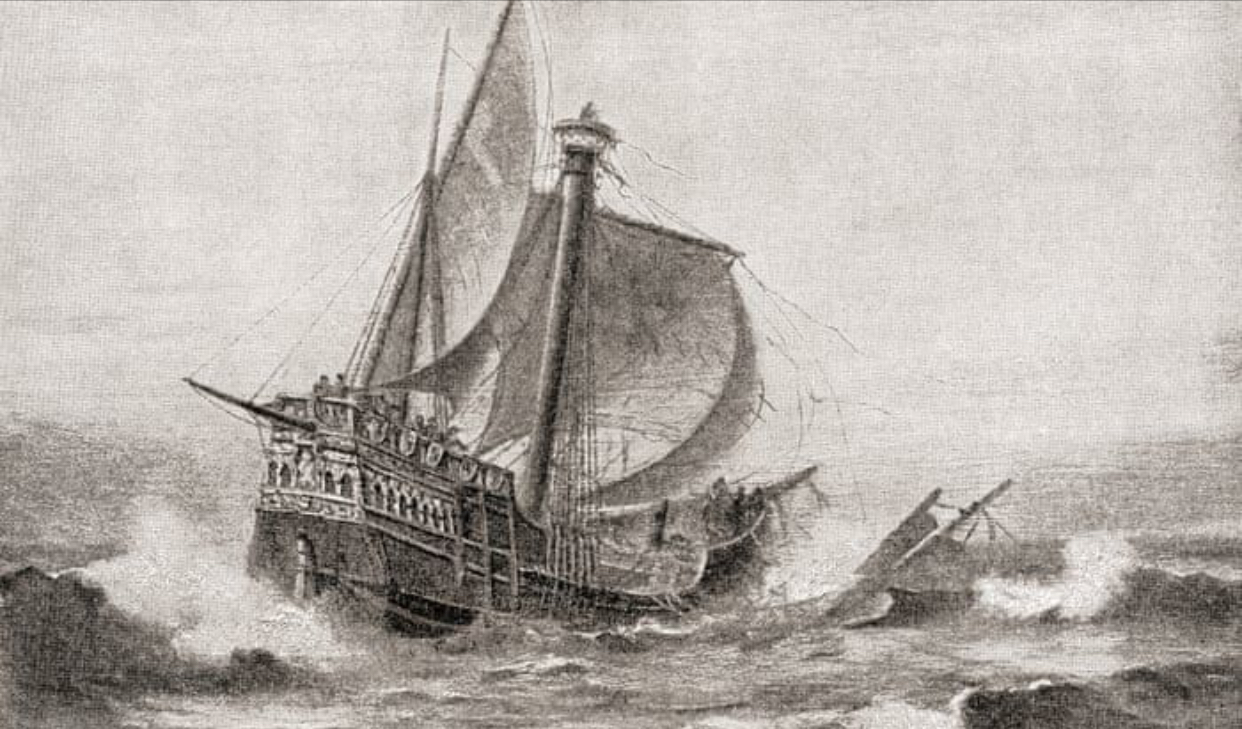
After the squall in the late afternoon of August 8th separated the English and Spanish ships which had fought all day off Gravelines, both fleets set sail northeast along the Flemish coast. The Duke of Medina Sidonia knew the Armada was past the point where it could rendezvous with the Duke of Parma’s army at sea. The wind had veered to the northwest so the Armada was forced to continue up the coast with the English fleet trailing behind. The hazards of the Zeeland banks lay up ahead and the Armada was headed for disaster on their current heading. The English ships could more easily sail into the wind so they were further out to sea than the Armada and could block any Spanish attempt to gain deeper water.
The English bombardment had severally damaged most of the Spanish ships, especially those which had opposed the joint assaults of Drake and Seymour. When the Armada reassembled after the storm, the Biscayan greatship Maria Juan foundered and sank, but fortunately most of her crew had been evacuated beforehand. During the night two large galleons from the Portuguese Squadron, San Felipe and San Mateo, were leaking so badly that their captains decided to drift landward and beach their ships on the Flemish sand banks so they could save their crews.
The following day a dozen Dutch shallow-draft warships led by Admiral Pieter Van der Does (accompanied by William Borlas, the English military governor of Flushing) captured both vessels on the sand flats. The crew of San Felipe gave up with out a fight (their officers having deserted them) but the crew of San Mateo offered a spirited resistance that killed many men on both sides. That evening the Dutch tossed the captured San Mateo crewmen over the side with their hands bound behind them and they were drowned. A storm in the night sank both ships off Flushing after they had been thoroughly ransacked. They had been holed by more than 300 cannon balls apiece during the fight off Gravelines so their hulls were too compromised to stay afloat any longer.
When dawn came on August 9th, Medina Sidonia’s flagship (San Martin) and five escorts were isolated from the rest of the Armada which lost its cohesion during the night. The main body of the fleet was a few miles downwind and Medina Sidonia’s small rearguard was facing the might of the English fleet alone. To the horror of Spanish observers, the Nuestro Senora de Begona went down with most of her crew while her captain was negotiating with Robert Crosse aboard his English galleon Hope regarding surrender terms. Afterward the English fleet charged toward the Spanish rearguard by column but each time the ships veered away without following a shot. It became clear the English were taunting their foes while conserving ammunition. Medina Sidonia found his ships drifting downwind toward the shoals in the face of the English provocations so he stopped trying to face down the English. He led his ships downwind toward the Spanish main body which had failed (or refused) to sail upwind to his aid.
During the next couple hours, the Armada was forced to skirt the coastal shallows as the English fleet sailed parallel to them further out to sea. As the water began changing colors the Spanish pilots knew they had come to the Zeeland sands. They nervously watched as the lead line casters counted less and less water under their ships’ keels. Prays were offered throughout the fleet for God’s intervention. The order went out for the Armada ships to drop anchors to slow their forward progress but the anchors merely dragged on loose sand. The end seemed near but suddenly the wind veered just enough to allow the Armada to tack seaward and avoid the disaster of running aground in rough seas. As Howard and his officers watched in chagrin, the Armada narrowly escaped yet again by the intervention of nature or God.
That evening both fleets reduced sails for the night as they slowly drifted toward the northern climes. Medina Sidonia held a council and after much debate he decided to head into the Norwegian Sea then westward to skirt the northern Scottish Isles. The pilots mapped a route designed to take them well past the west coast of Ireland before turning south toward Spain. Water and food rationing was implemented because they would barely have enough to last the 2,100-mile journey. The ‘Enterprise of England’ was over, but the Armada’s odyssey had just begun. It would be a grueling voyage home.
Meanwhile, Howard held a council and they decided to follow the Armada toward Scotland’s Firth of Forth, after which the fleet would return home because the threat of a Spanish landing in a British port would be gone. Howard and his admirals took stock of the situation: they were disappointed that the Armada had escaped intact but were grateful for their slight casualties and negligible shipboard damage. Drake summed up the campaign with optimistic words: “God hath given us so good a day in forcing the enemy so far to leeward as I hope to God the Prince of Parma and the Duke Medina Sidonia shall not shake hands this few days, and whenever they shall meet, I believe neither of them will greatly rejoice of this day’s service.”
ELIZABETH’S TILBURY SPEECH
19 August 1588
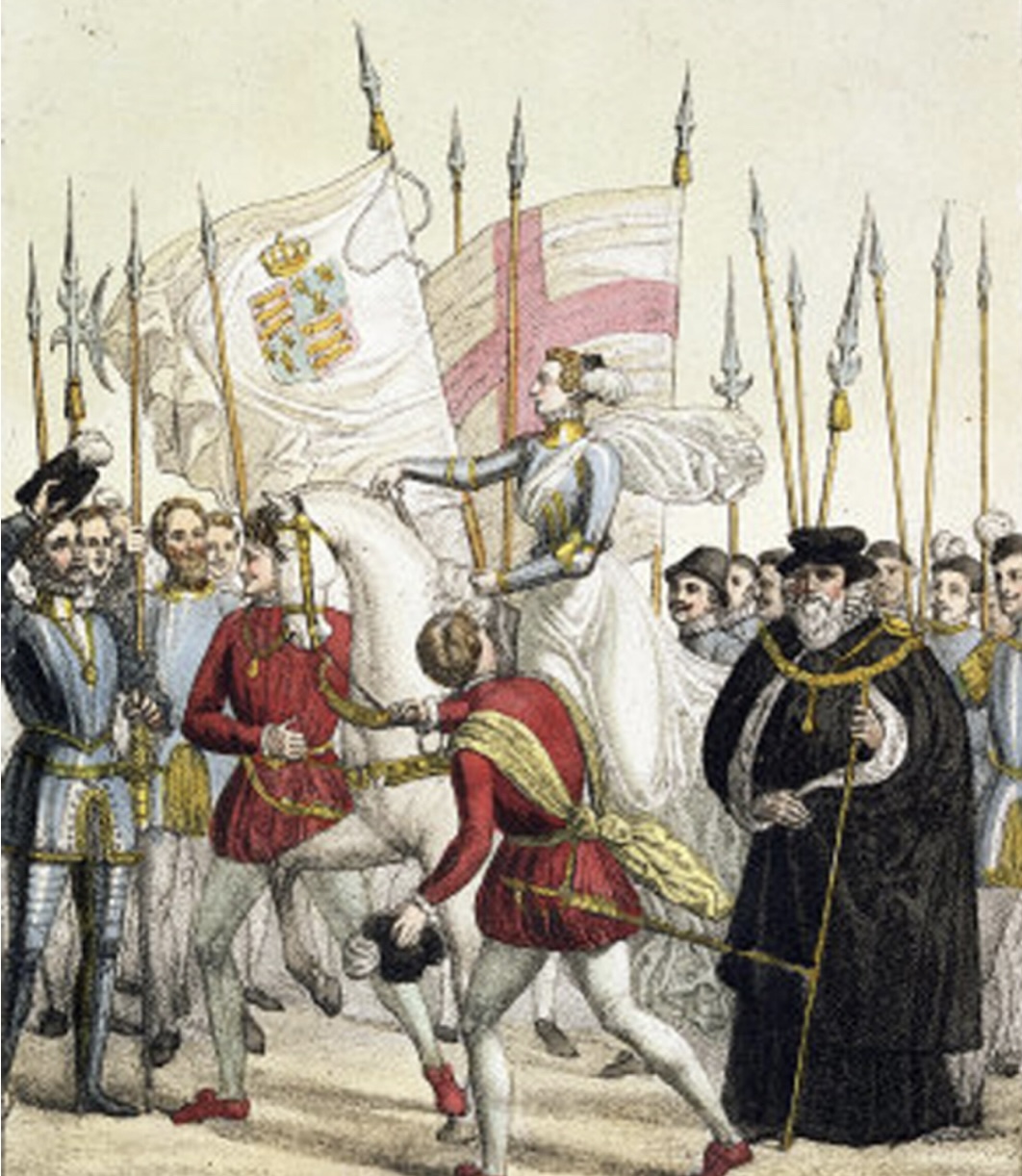 After the pivotal Battle of Gravesend on August 8th (during which time the English Fleet brutalized the Armada with close-in cannon fire and drove it into the North Sea), Queen Elizabeth anxiously awaited news of the outcome. Lord Charles Howard had dispatched a messenger with an abbreviated account of the battle but the Queen lacked salient details and did not know whether the Armada would return. The Duke of Parma and his army of seventeen thousand professional soldiers at Dunkirk were waiting to embark on troop transports and make the short crossing to England on the impending spring tide. Since the English fleet was pursuing the Armada northward, Parma’s forces might make a surprise sortie and land around the mouth of the Thames in the coming days.
While Elizabeth waited at St. James’ Palace, she called a meeting of her Privy Councilors to discuss the military situation. To meet an expected invasion downriver, she had dispatched Robert Dudley, the Earl of Leicester, to command a militia army of approximately nine thousand men from Essex and Kent counties. Leicester was based at Tilbury near the mouth of the Thames where a black house and fort were being constructed to resist an attempt by Parma to move his forces upriver toward London. Meanwhile, London had mobilized ten thousand militiamen who were barricading every street opening and preparing to fight the Spanish block-by-block. Lord Hunsdon (Henry Carey, son of Elizabeth’s aunt, Mary Boleyn) was the 62-year-old Lord Chamberlain of the Queen’s Household. He had some previous military experience so he was selected to lead a reserve army near Westminster where the Queen would be kept in relative safety. Unfortunately, that army existed only on paper.
Elizabeth realized the realm was unprepared to meet Parma’s army on English soil but she was chafing at inactivity and desired to raise morale, so she readily took up a written offer from Leicester to review his troops at Tilbury.
On August 18th, Elizabeth took to her royal barge and led a military style procession of her household staff (and Privy Councilors) down the Thames. A couple hours later she emerged on deck wearing a military breastplate over her otherwise fashionable attire. When the procession pulled into a ferry dock on the north side of the Thames, she had a clear view of Leicester’s military preparations. A bridge of boats connecting West Tilbury to Gravesend was incomplete. An Italian engineer named Federigo Giambelli had recently constructed a boom across the eight-hundred-foot-wide river but it had broken in half at the first flood tide. The boom was made from anchor chains, ship masts and hemp cables that were secured to river barges in several sections. A two-story, D-shaped, brick blockhouse loomed over the shoreline on the Essex side. It contained twenty-three cannons that commanded the river. A brick-lined earthwork was under construction on the landward side to defend the blockhouse from an enemy incursion on that quarter.
Leicester brought the Queen through a gate in the rampart that enclosed a modest yard behind the blockhouse. Dozens of laborers had been working on the fortifications; they now stood with their hats in their hands as the Queen approached. Giambelli stood at their frontage; he was introduced to the Queen before Leicester brought her inside the blockhouse to inspect the cannons. Afterward they moved inland to inspect the nearby army encampment.
The yeomen of the guard and her gentlemen pensioners marched up a raised causeway that led inland over a marsh toward higher ground. They were followed by a dozen minstrels playing fifes and drums. The Queen was preceded by the Earl of Ormond who walked on foot carrying the ceremonial Sword of State, then two pages dressed in white velvet; one carrying the Queen’s silver casque on a white velvet cushion, and the other leading her horse by a rein. The Queen rode on a white gelding flanked on either side by two mounted men: the Master of the Horse (her cousin, the twenty-three-year-old Robert Devereaux, Earl of Essex); and Leicester, who rode with his head uncovered. Trailing her on foot was an armored soldier, Colonel Sir John Norris, who was Leicester’s military advisor and one of England’s few experienced army commanders. Leicester had arranged an honor guard along their route, so at thirty-four intervals within the space of a mile the Queen passed rows of pikemen who couched their eighteen-foot weapons as she passed.
The encampment was a close arrangement of tents surrounded by a wooden palisade and trench. Due to its newness, it was clean and orderly, and reminded Elizabeth of a country fair. It was situated on common strip fields outside the village center of West Tilbury and between the lofty tower of St. James’ Church and an old windmill. Her household guards arranged themselves in orderly rows outside the palisade, but Elizabeth and a few companions entered the camp through its main gate and slowly proceeded between every row of tents and through every corner of the encampment. Soldiers stood at attention and uttered ‘my Queen’ or ‘Gloriana’ as she passed. Many of them wept openly at the site of her. To some, she seemed like a manifestation of Diana or some other heroic biblical woman, while to others, she seemed like an avenging angel of the Lord. Despite her lack of bodyguards, she seemed untouchable, and no one held any thought of accosting her; rather, they looked upon her with quiet reverence until she passed, then they broke into cheers.
After completing a circuit of the camp, Elizabeth and her entourage followed a narrow lane northward for a few miles which took them over Mucking Heath to her lodging at ‘Cantis House (Saffron Gardens) that was owned by a local magistrate named Edward Rich. The house was near the village of Horndon-on-the-Hill. She was entertained there for the rest of the day.
The next day (August 19th), at mid-morning, Elizabeth arrived by procession to Leicester’s pavilion which was near the camp but further west along higher ground overlooking the blockhouse and the town of Gravesend across the river. Next to the pavilion were the richly adorned tents of Leicester’s staff officers beside a cleared area reserved for the military parade. Elizabeth again wore her ornamental armor, and she reclined atop the pavilion while the troops prepared for a parade.
The first man she saw was Lord Montagu riding at the head of his company of horse troopers with his son and grandson on either side of him. Gaudy plumes affixed to the troopers’ helmets bobbed as the horses cantered by. Ranks of pike-bearing militiamen followed and then a thousand musketeers on loan from London marched by, followed by more horse troopers and lastly Leicester arrayed in splendid armor atop his war horse.
After the parade, the Queen gave a rousing speech that included the following words: “Let tyrants fear. I have always so behaved myself that, under God, I have placed my chief strength and safeguard in the loyal hearts and good will of my subjects; and therefore I am come amongst you, as you see, at this time, not for my recreation and disport, but being resolved, in the midst and heat of the battle, to live and die amongst you all; to lay down for my God, and for my Kingdom, and my people, my honor and my blood, even in the dust.
“I know I have the body but of a weak and feeble woman, but I have the heart and stomach of a king, and of a king of England too, and think foul scorn that Parma or Spain, or any prince of Europe, should dare to invade the borders of my realm: to which rather than any dishonor shall grow by me, I myself will take up arms, I myself will be your general, judge, and rewarder of every one of your virtues in the field.”
That evening, Elizabeth heard rumors that Parma was about to sally forth and she wanted to remain to personally contest his landing, but her ministers persuaded her instead to return to London and safety. Parma never came. Once he determined the Armada would not be returning, he decided to put his army into winter quarters inland. He would focus his attentions on subduing the breakaway Dutch provinces. The threat of invasion was past but Elizabeth’s martial legend had just begun.
Subscribe
Enter your email below to receive updates.
 Armada: The Invincible