8 August 1588
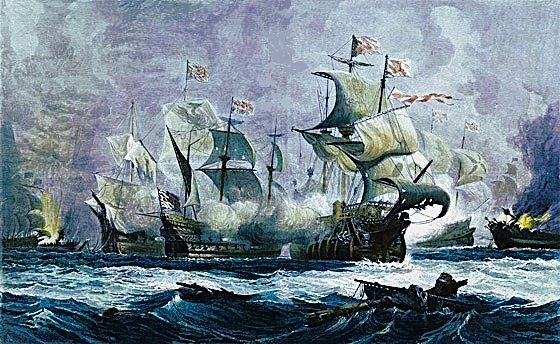
Just before midnight on 7 August 1588, the English high admiral, Lord Charles Howard, had sent six fireships into the midst of the Spanish Armada that was anchored in dense ranks off Wissant, France. The vast flames of burning masts and rigging and the blasts of ruptured double-loaded cannons had panicked the Spanish ship captains. Despite instructions to orderly evade any fireships and return to their original moorings, the Armada’s captains had fled downwind up the coast in a disordered route.
When dawn broke on August 8th, Howard nervously peered northward expecting to be disappointed. Too often had he seen the Armada reforming its vaunted defensive crescent after every battle. To his delight, he saw that the Armada ships were scattered to the horizon. The fireship attack had been successful. Only a single cluster of five warships had staked ground seven miles up the coast. The Spanish high admiral, the Duke of Medina Sidonia (aboard his flagship San Martin with four faithful escorts) would bear the brunt of the initial English assault.
During yesterday’s war council, it was agreed that Howard would lead the first column against the enemy, followed by the other four columns. When dawn revealed an isolated Spanish warship limping along the adjacent shoreline, Howard altered the plan. The galleass San Lorenzo, carrying Admiral Hugo de Moncado, had collided with a neighboring ship during the fireship attack. She had lost her mainmast and rudder and listed heavily to one side. Once Moncado realized his ship was isolated and likely to sink, he made for the safety of neutral Calais. Unfortunately, San Lorenzo ran aground just short of her destination and toppled over. She was soon stranded on the flats as the tide receded while Howard and Seymour’s columns bore down on her position. Howard wanted to seize a prize ship in pursuit of his own glory. He figured he would have plenty of time to reinforce Drake once the battle blossomed up north.
Howard sent several small vessels toward the stranded galleass. The assault force was directed by Captain John Fisher aboard the London merchant ship Margaret and John, which promptly ran aground near its target. Nevertheless, Fisher partnered with Howard’s nominated land captain, Amyas Preston, and a plan was hatched to deposit a hundred English soldiers onto the sand flats while a dozen small ships provided fire support. After a short but sharp engagement, most of San Lorenzo’s crewmen fled on foot toward shore but dozens of defenders were killed or captured. Admiral Moncado was fatally shot while leading a counter assault on foot, while Preston was shot through the hip (he later recovered). Three hundred convict oarsmen were liberated and a treasure coffer containing 21,000 gold escudos (the equivalent of 1.8 million pounds sterling in modern currency) was captured.
While the Englishmen were ransacking San Lorenzo, curious townsfolk wandered over the sand flats from Calais. A scuffle ensued and some townsfolks were robbed of their clothes and possessions. The enraged Calais governor ordered his fortress to open fire on the Englishmen who soon returned to their ships. Margaret and John was hit by cannon balls but later refloated and rejoined the fleet. Howard did not want to start a war with France, so he led his ships up the coast toward Gravelines where a giant sea battle was taking shape.
In Howard’s absence, Sir Francis Drake (his vice admiral) led his column against San Martin and sailed close enough to hole her many times with his heavy ordnance. Several other galleons in his column followed suit and soon San Martin was leaking badly. Drake then noticed Admiral Recalde’s giant flagship San Juan rallying a dozen warships a few miles up the coast. Recalde was trying to reform a wing, while reinforcements coming to San Martin’s aid would probably try to form another wing. Drake led his column downwind to disrupt Recalde’s efforts, leaving San Martin and her rescuers in the care of four English columns (Howard’s column would join the fighting on that quarter).
Rear Admiral Martin Frobisher’s column was the next to savage San Martin. Frobisher’s greatship Triumph was similarly sized as his opponent and he sailed close enough to make his shots count. Other English ships tangled with the relieving ships and a major battle broke out in that quarter. Edward Fenton, aboard Mary Rose, fought the huge galleon San Marcos for over an hour, pounding her superstructure into ruins and weakening her hull to the extent that she would need three cables running beneath her keel to stay intact. Every time the Spanish tried to grapple and board, English ships would veer away then return from another wind angle to fire more volleys. Eventually the Spanish ships started running out of ammunition allowing the English to come close and fire effectively into enemy hulls. English fire killed most of the opposing soldiers, lessening the threat of Spanish anti-personnel fire.
Meanwhile, Drake’s attack against a dozen Spanish combatants further north was running out of steam but he was reinforced by Lord Henry Seymour (aboard the powerful galleon Rainbow) who led several warships to that sector. Seymour’s fresh ships were fully stocked with ammunition which he fired from close quarters against several Spanish galleons in Recalde’s burgeoning wing. Seymour and Drake managed to cut off the Portuguese galleons San Felipe and San Mateo and battered them with cannonballs. Both ships lost much of their men and were so badly damaged that they would run aground to avoid sinking during the coming night. Four Spanish warships tried to rescue their colleagues but they had no ammunition left. They received a brutal beatdown by Seymour and Drake’s ships. Trinidad Valencia fled back to the relative safety of Recalde’s nascent wing but the other three collided and became entangled. San Juan de Sicilia, Maria Juan, and Nuestro Senora de Begona drifted helplessly as more than a dozen English ships fired volley after volley into them from close range (all three ships would sink from damage after the battle ended).
Drake and Seymour were later joined by Howard and the rest of the English fleet which had sailed downwind to join in the slaughter. Medina Sidonia and his relief ships used the respite to patch their most serious leaks and replace damaged rigging and sails. By the early afternoon they joined the melee up north. Howard temporarily withdrew upwind so his ships could make minor repairs.
Seeing that the Armada was using the respite to reorganize its ranks, Howard led his columns forward again and ranged freely among the enemy ships which had no ammunition left to resist. Auxiliary ships and supply ships were bombarded from close range and the Armada was nearing destruction but nature chose to intervene. A violent storm blew up from the south and separated the belligerents. Howard’s ships withdrew upwind, anchored in place, and rode out the storm. An hour later (around five o’clock), Howard was amazed to see that the Armada had retired downwind and reformed in deep water a few miles up the coast.
Around six o’clock the Armada raised anchors and began sailing northeastward up the coast. Howard barely had enough ammunition left to support an hour’s worth of heavy fighting, so he decided not to reengage the enemy after the conclusion of their nine-hour battle. As Howard began to follow the fleeing enemy, he was disappointed that the Armada had escaped intact, but he was consoled that he had driven them downwind past the shoals around Dunkirk. If the wind held, the Armada would be unable to rendezvous with Parma’s troop transports. The Armada had failed in its mission and the pursuit had begun.
 Armada: The Invincible
Leave a comment